Italian Cuisine
Panna Cotta with Berry Coulis
By Francesca Rolli, Pastry Chef trained in Piedmont and dessert instructor
Rate this recipe
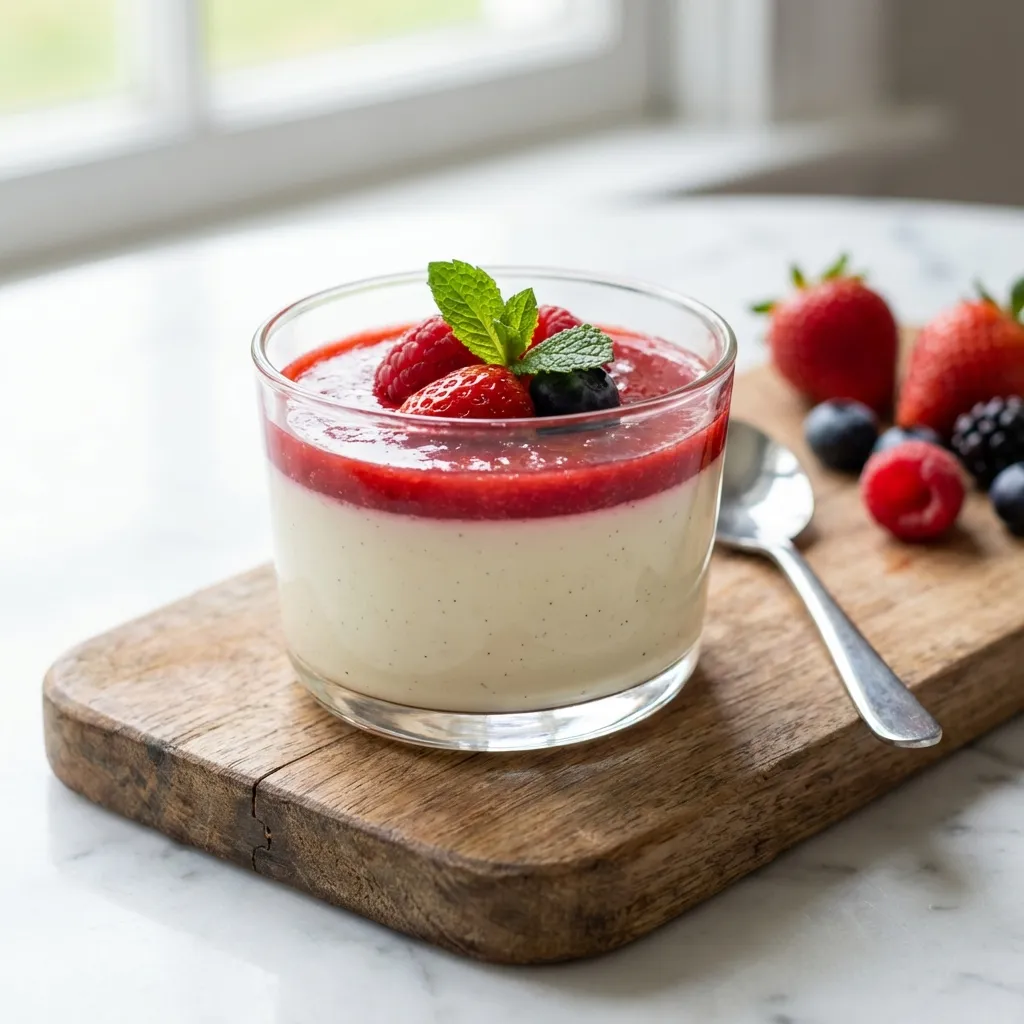
Panna cotta, literally 'cooked cream,' is the elegant pride of Piedmont in northwestern Italy, a region whose rolling Langhe hills are famous for hazelnuts, Barolo wine, and rich dairy. The dessert is widely said to have originated in the Langhe in the early 20th century, where local cream was simply sweetened, set with gelatin, and turned out into a trembling, snow-white dome. Its beauty lies in its restraint: no eggs, no baking, no fuss, just exceptional cream coaxed into a silky custard that should quiver when the plate is nudged. This version stays true to the Piedmontese ideal, perfuming the cream with a real split vanilla bean rather than extract, so flecks of seed speckle the set custard. The single technical key is the gelatin. It must be bloomed in cold water first so it dissolves smoothly into the warm cream, and used in just enough quantity to set the cream while keeping it barely jiggly; too much turns panna cotta rubbery, too little and it slumps. Crucially, the cream is heated only to a gentle simmer, never a hard boil, which would scald it and weaken the gelatin's set. A bright berry coulis of strawberries and raspberries, sharpened with lemon, cuts the richness and gives the pale custard a jewel-toned crown. Make it a day ahead for a dinner party and you have the most effortless showstopper in the Italian repertoire, a dessert that has traveled from a Piedmontese farmhouse to white-tablecloth restaurants around the world.
Ingredients
Serves 4Instructions
- 1
Pour 3 tablespoons of cold water into a small bowl and sprinkle the gelatin over it. Let stand for 5-10 minutes to bloom.
- 2
In a saucepan over medium heat, combine the heavy cream and 1/3 cup sugar. Scrape the seeds from the vanilla bean into the cream and add the pod.
- 3
Heat the mixture until it begins to simmer (do not let it boil vigorously). Remove from heat.
- 4
Add the bloomed gelatin to the hot cream and whisk until completely dissolved. Remove the vanilla pod.
- 5
Pour the mixture into four ramekins or cups. Let cool to room temperature, then refrigerate for at least 4 hours until set.
- 6
To make the coulis, combine mixed berries, 2 tablespoons sugar, and lemon juice in a small saucepan. Simmer for 10 minutes until berries break down.
- 7
Blend the berry mixture and strain through a fine mesh sieve to remove seeds (optional).
- 8
Serve the chilled panna cotta topped with the berry coulis.
Chef's Tips
- ✦ Bloom the powdered gelatin in cold water for the full 5 to 10 minutes before using; this hydrates the granules so they dissolve smoothly and you avoid grainy, lumpy custard.
- ✦ Heat the cream only until it just begins to simmer, never to a hard boil. Boiling can scald the cream and weaken gelatin's setting power, leaving the panna cotta loose.
- ✦ Whisk the bloomed gelatin into the hot (not boiling) cream until completely dissolved, then run the mixture through a fine sieve before pouring to catch any undissolved bits and the vanilla pod.
- ✦ For clean unmolding, lightly oil the ramekins first, then dip the set panna cotta briefly in warm water and invert; to serve in the cup instead, simply spoon the coulis on top.
- ✦ Chill at least 4 hours, ideally overnight, and make the coulis while it sets. Strain the blended berries through a fine sieve for a smooth, glossy sauce, and let it cool before spooning over the cold custard.
Ingredient Substitutions
-
powdered gelatin → gelatin sheets or agar-agar
About 4 standard sheets equal 2.5 tsp powdered gelatin; soak sheets in cold water, then squeeze and dissolve. For a vegetarian set, use agar-agar, but it sets firmer and must be boiled, giving a slightly less silky texture.
-
heavy cream → part whole milk or half-and-half
Replacing up to half the cream with whole milk makes a lighter panna cotta. The classic Piedmontese version is all cream for maximum richness; the more milk you use, the less luxurious the mouthfeel.
-
vanilla bean → 1 to 2 tsp vanilla bean paste or pure vanilla extract
A real bean gives the best flavor and pretty flecks. Vanilla bean paste keeps the speckles; extract works but add it off the heat so the aroma does not cook off.
-
mixed berries → frozen berries, or other fruit like mango or passion fruit
Frozen strawberries and raspberries work year-round and break down beautifully. Stone fruit or tropical purees make lovely alternative coulis; just adjust sugar to the fruit's sweetness.
-
sugar → honey or maple syrup
You can sweeten the cream with honey or maple for a different note, but they will tint the white custard slightly. Reduce the amount a touch since both are sweeter and add their own flavor.
Tags
Frequently Asked Questions
What does panna cotta mean? ▼
Panna cotta is Italian for 'cooked cream.' It is a chilled dessert from the Piedmont region made by gently heating sweetened cream, setting it with gelatin, and serving it cold, here with a berry coulis.
Why didn't my panna cotta set? ▼
The two usual causes are too little gelatin and overheating the cream. Make sure the gelatin is fully bloomed and dissolved, heat the cream only to a gentle simmer rather than a hard boil, and chill for at least 4 hours, ideally overnight.
Can I make panna cotta without gelatin? ▼
Yes, for a vegetarian version use agar-agar in place of the powdered gelatin. Agar must be brought to a boil to activate and sets firmer, so the texture will be a little less wobbly and silky than the gelatin original.
How far ahead can I make panna cotta? ▼
It is an ideal make-ahead dessert. Prepare it up to 2 days in advance and keep it covered in the refrigerator. The berry coulis can also be made ahead and stored chilled, making this perfect for a dinner party.
Should I unmold the panna cotta or serve it in the cup? ▼
Either works. To unmold, lightly oil the ramekins before filling, then dip the set custard briefly in warm water and invert onto a plate. For a no-fuss presentation, simply leave it in the ramekin or cup and spoon the coulis on top.
Can I use frozen berries for the coulis? ▼
Absolutely. Frozen strawberries and raspberries work very well and are available year-round. Simmer them with the sugar and lemon juice until they break down, then blend and strain through a fine sieve to remove the seeds if you prefer a smooth coulis.