British Cuisine
Scotch egg
By Marcus Pemberton
Rate this recipe
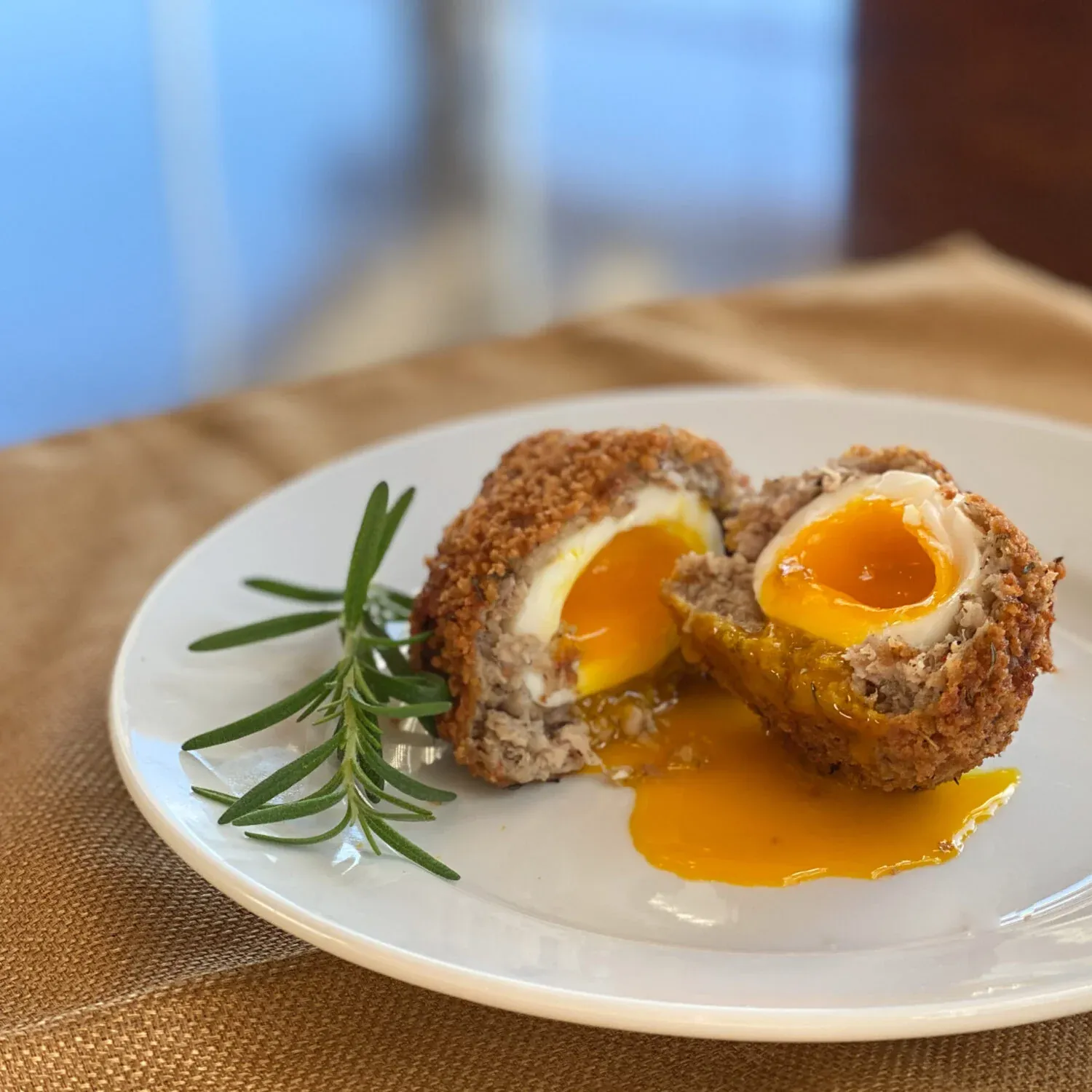
Few snacks are as defiantly British as the Scotch egg: a whole boiled egg encased in seasoned sausage meat, rolled in breadcrumbs, and fried until bronzed and crackling. Its origins are happily disputed. The London department store Fortnum & Mason claims to have invented it around 1738 as portable food for travelers heading out by coach, though similar meat-wrapped eggs appear in Mughal cookery and in English recipe books under other names. The "Scotch" likely has nothing to do with Scotland - it may derive from "scotching," an old term for mincing or processing the meat. Whatever the truth, the Scotch egg earned its place at the heart of the British picnic and the gastropub bar, where a properly made one - with a jammy, just-set yolk - has become a point of pride. This recipe gives you the choice: boil six to seven minutes for a soft, runny center or nine to ten for a firm, picnic-sturdy egg. The technique is all in the wrapping. Sausage meat is seasoned and pressed thin, the floured egg is cradled in the center, and the meat is sealed seamlessly around it before a classic flour-egg-breadcrumb coat. Fried at a steady 350 degrees, the crust shatters to reveal layers of crisp crumb, savory pork, and tender egg. Serve warm with mustard or cold from the fridge - either way it is one of Britain's most satisfying handheld pleasures.
Ingredients
Serves 4Instructions
- 1
Place 4 eggs in boiling water and boil for 6-7 minutes (for soft center) or 9-10 minutes (hard boiled). Peel and set aside.
- 2
Mix the sausage meat with salt, pepper, and herbs if desired (parsley or sage). Divide into 4 portions.
- 3
Flatten a portion of sausage meat into an oval. Dust a boiled egg with flour, then place it in the center of the meat. Wrap the meat around the egg to enclose it completely.
- 4
Set up a breading station: one bowl with flour, one with beaten egg, and one with breadcrumbs.
- 5
Roll each meat-wrapped egg in flour, dip in beaten egg, and coat with breadcrumbs.
- 6
Heat oil in a deep fryer or pot to 350°F (175°C). Fry the eggs for 5-7 minutes until golden brown and the sausage meat is cooked through.
- 7
Drain on paper towels and let cool slightly before serving.
Chef's Tips
- ✦ For a jammy center, boil exactly 6 to 7 minutes then plunge the eggs into ice water to stop the cooking and make peeling easy.
- ✦ Dust the peeled egg with flour before wrapping - it gives the sausage meat something to cling to and prevents gaps.
- ✦ Press the sausage meat thin and even between sheets of plastic wrap, then mold it around the egg and pinch any seams closed to avoid splits while frying.
- ✦ Chill the wrapped, breaded eggs for 20 to 30 minutes before frying so the coating sets and the meat firms up.
- ✦ Keep the oil at a steady 350 degrees and fry only two at a time - crowding drops the temperature and gives a greasy crust.
- ✦ Fry until deep golden, about 5 to 7 minutes, then rest on paper towels so the carryover heat finishes cooking the sausage to a safe 160 degrees F (71 degrees C).
Ingredient Substitutions
-
sausage meat → skinned pork sausages
Squeeze the meat out of good-quality sausage links if you cannot find loose sausage meat.
-
sausage meat → plant-based sausage meat
Vegetarian sausage meat wraps and fries well; chill the wrapped eggs first to help them hold shape.
-
breadcrumbs → panko breadcrumbs
Panko gives an extra-crisp, craggy crust; the recipe already lists it as an option.
-
breadcrumbs → crushed gluten-free crackers or GF breadcrumbs
Use a gluten-free crumb and GF flour to make the whole dish gluten free.
-
flour → cornstarch or rice flour
Either dusts the egg and helps the coating grip just as well as wheat flour.
-
vegetable oil → sunflower or peanut oil
Any neutral oil with a high smoke point works for deep frying at 350 degrees.
Tags
Frequently Asked Questions
How do I get a runny or jammy yolk? ▼
Boil the eggs for just 6 to 7 minutes, then cool them immediately in ice water. The shorter boil leaves the center soft so it stays jammy after the brief fry.
How do I know the sausage meat is cooked through? ▼
Fry until the coating is deep golden, about 5 to 7 minutes, and the pork reaches an internal temperature of 160 degrees F (71 degrees C). An instant-read thermometer pushed into the meat is the surest check.
Can I bake Scotch eggs instead of frying them? ▼
Yes. Spray the breaded eggs with oil and bake at 400 degrees F (200 degrees C) for about 25 to 30 minutes, turning once, until golden and the pork is cooked through. The crust will be a little less shattering than fried.
Can I make Scotch eggs ahead of time? ▼
Absolutely. Assemble and bread them up to a day ahead and keep chilled, then fry just before serving. Cooked Scotch eggs are also traditionally eaten cold from the fridge.
How should I store leftovers? ▼
Refrigerate cooked Scotch eggs in an airtight container for up to 3 days. Eat them cold or warm gently in the oven; if you used a runny yolk, store no more than a day for best quality.
Why did my coating fall off or the meat split? ▼
Usually the egg was not floured, the seams were not sealed, or the eggs went into the oil too warm. Flour the egg, pinch all seams shut, and chill the breaded eggs before frying.
Can I make these gluten free? ▼
Yes. Swap the flour for cornstarch or rice flour and use gluten-free breadcrumbs, and confirm your sausage meat contains no wheat rusk, which many traditional blends do.