British Cuisine
Victoria Sponge Cake
By Beatrice Hartwell
Rate this recipe
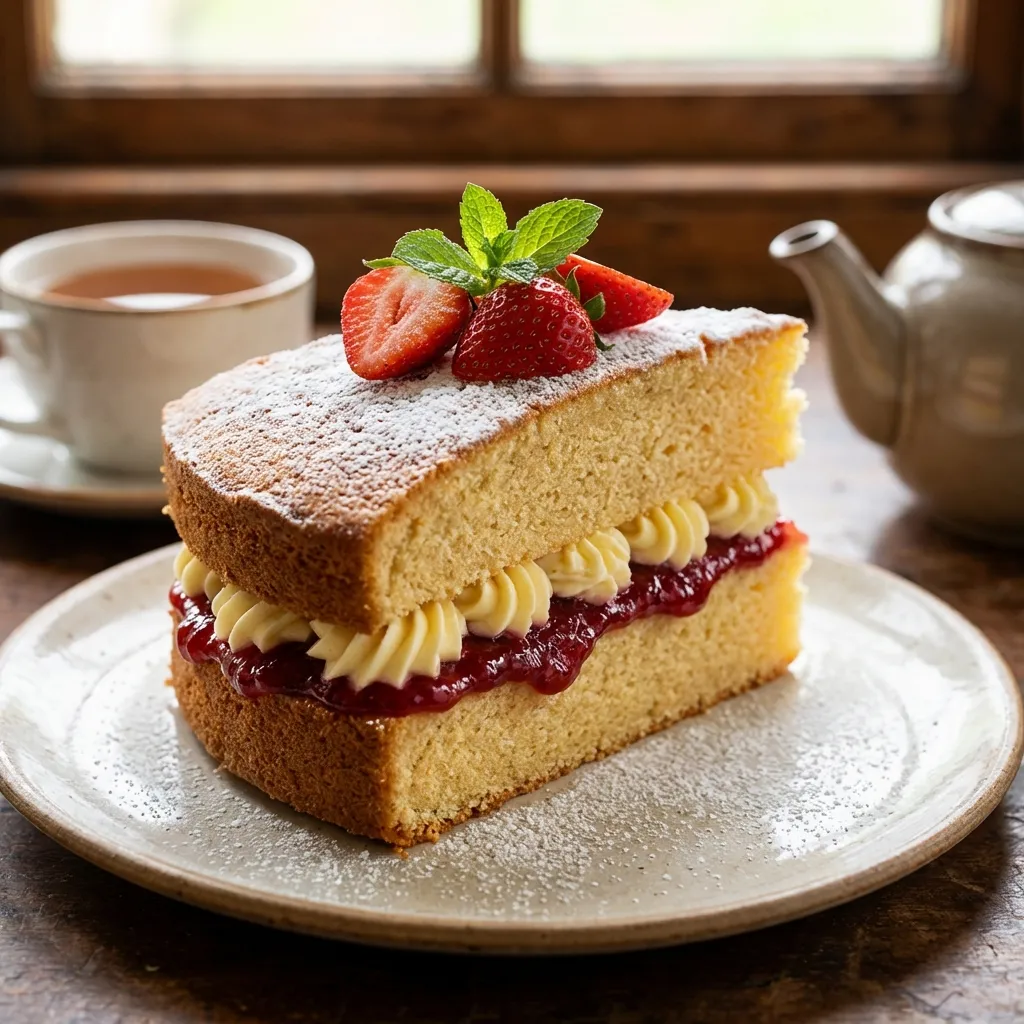
Named for Queen Victoria, who reputedly enjoyed a slice with her afternoon tea, the Victoria sponge is the cornerstone of British baking and the cake by which every village fete and Women's Institute competition is quietly judged. Its genius lies in restraint: there is nowhere to hide. Equal weights of butter, sugar, eggs, and flour produce a sponge that should be pale gold, level, and tender enough to yield under a fork yet sturdy enough to carry a generous seam of strawberry jam. This version sandwiches the two layers with both jam and softly whipped cream, then finishes with nothing more than a snowfall of powdered sugar across the top. No fondant, no frosting, no flourish. What makes it work is technique rather than ingredients: thoroughly creaming the butter and sugar to trap air, beating in the eggs gradually so the batter never splits, and folding the self-raising flour in by hand to keep the crumb light. The result is a teatime classic that has survived two centuries because it tastes of butter, vanilla, and summer fruit, and because almost anyone can master it with a little practice and a reliable oven.
Ingredients
Serves 10Instructions
- 1
Preheat oven to 350°F (175°C). Grease and line two 8-inch round sandwich tins.
- 2
In a large bowl, cream the butter and sugar until pale and fluffy.
- 3
Beat in the eggs one at a time, adding a little flour if it starts to curdle. Stir in the vanilla.
- 4
Fold in the remaining flour and baking powder using a large metal spoon.
- 5
Divide mixture between the two tins. Bake for 25 minutes until golden and well risen.
- 6
Cool in tins for 5 minutes, then turn out onto a wire rack to cool completely.
- 7
Whip the cream until soft peaks form.
- 8
Spread jam onto one cake, top with whipped cream, and sandwich with the other cake. Dust with powdered sugar.
Chef's Tips
- ✦ Have the butter and eggs at full room temperature before you start; cold ingredients refuse to cream and will curdle the batter.
- ✦ Cream the butter and sugar for a full four to five minutes until visibly pale and fluffy, this is the air that makes the sponge rise.
- ✦ Add the eggs one at a time and drop in a spoonful of the measured flour if the mixture looks like it's about to split.
- ✦ Fold, don't beat, once the bulk of the flour goes in, use a large metal spoon and a light hand to protect the air you worked in.
- ✦ Weigh your batter and divide it evenly between the two tins so both layers bake to the same height for a level finish.
- ✦ Test for doneness by pressing the center lightly; a baked sponge springs back, and the edges will have just begun to pull from the tin.
- ✦ Let the sponges cool completely before filling, or the whipped cream will melt and the jam will slide.
Ingredient Substitutions
-
self-raising flour → all-purpose flour plus 2 teaspoons baking powder
Whisk the baking powder evenly through the flour before using so the sponge rises uniformly.
-
strawberry jam → raspberry jam or lemon curd
Raspberry adds a sharper note; lemon curd gives a tangy contrast to the cream.
-
heavy cream → vanilla buttercream
Buttercream is more stable for transporting or making ahead, since it won't weep like whipped cream.
-
butter → baking block or stick margarine
Use a firm baking block rather than a soft spread so the batter creams properly and holds air.
-
vanilla extract → the scraped seeds of half a vanilla pod
Real pod seeds give visible flecks and a deeper aroma; add them with the eggs.
-
sugar → caster (superfine) sugar
Finer crystals dissolve faster during creaming, giving an even smoother crumb.
Tags
Frequently Asked Questions
Why did my Victoria sponge come out dense and flat? ▼
Density usually means too little air was creamed into the butter and sugar, or the flour was beaten in too hard and knocked the air back out. Make sure your baking powder and self-raising flour are fresh, and fold gently.
Can I make a Victoria sponge ahead of time? ▼
Bake the sponges up to a day ahead and store them unfilled in an airtight container. Fill with jam and cream only a few hours before serving so the cream stays firm and the sponge doesn't go soggy.
How should I store the finished cake? ▼
Because of the whipped cream, keep the filled cake refrigerated and eat it within two days. Bring it back to room temperature for about 20 minutes before serving for the best flavor and texture.
Can I freeze Victoria sponge? ▼
Yes, freeze the unfilled, cooled sponges wrapped well in plastic for up to three months. Thaw at room temperature, then fill fresh; cream-filled cake does not freeze nearly as well.
How do I scale this recipe for a larger or smaller cake? ▼
The classic ratio is equal weights of butter, sugar, flour, and eggs. Weigh your eggs in their shells and match the other three to that weight, then adjust tin size and bake time accordingly.
Why did my batter curdle after adding the eggs? ▼
Curdling happens when cold eggs are added too fast to the creamed butter. Bring eggs to room temperature, add them one at a time, and beat in a spoonful of flour with each to stabilize the mixture.
Can I use frozen or out-of-season strawberries instead of jam? ▼
Jam is traditional and gives the right set, but you can layer thin slices of fresh strawberry alongside the jam for extra freshness. Avoid using only macerated fruit, as the juice will make the sponge soggy.